> ## Documentation Index
> Fetch the complete documentation index at: https://docs.kimia.live/llms.txt
> Use this file to discover all available pages before exploring further.
# Architecture
> How six Anchor programs compose into one fixed-income stack.
Kimia is not a monolith. Every responsibility, matching engine, hedging, tokenization,
AMM, stablecoin, is a separate Anchor program, and the programs talk to each other
via CPI. This makes each piece usable in isolation.
## Program map
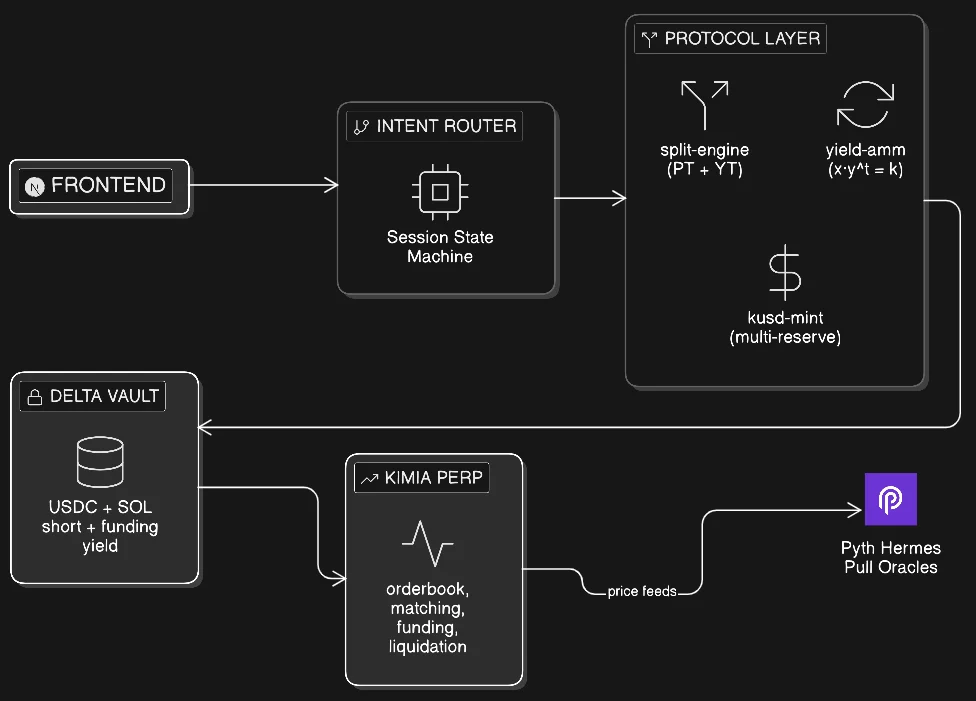
Matching engine, orderbook, funding, liquidation, spot pool.
Holds USDC, opens/maintains a SOL-PERP short, mints vault shares.
Wraps vault shares into `PT` + `YT` with MasterChef-style yield accounting.
Yield-space AMM for PT ↔ underlying, with prices that decay into par at maturity.
Session state machine that verifies a multi-step fixed-rate lock succeeded.
Stablecoin with multi-reserve backing and staking-based yield distribution.
## Layered view
 ## CPI graph
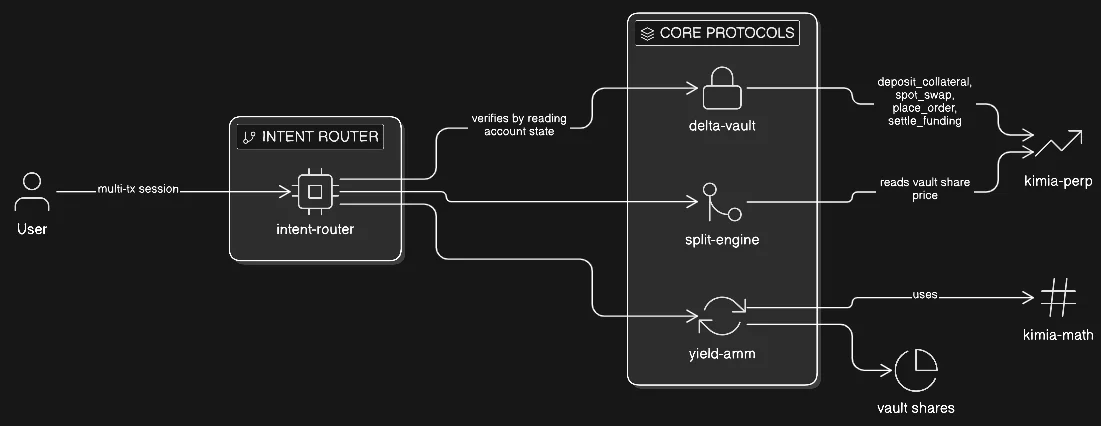
Arrows mean "A invokes B via CPI" between Kimia's own programs. External
programs can CPI in the same way, but note that Kimia does not publish its
program crates to crates.io — consumers add them as `path` or `git`
dependencies in their own `Cargo.toml` with `features = ["cpi"]`.
## CPI graph
Arrows mean "A invokes B via CPI" between Kimia's own programs. External
programs can CPI in the same way, but note that Kimia does not publish its
program crates to crates.io — consumers add them as `path` or `git`
dependencies in their own `Cargo.toml` with `features = ["cpi"]`.
 ## The fixed-rate lock, three transactions
The canonical user flow uses all five programs to turn USDC into a guaranteed fixed rate:
User calls `delta-vault::deposit(amount, open_perp=true)`.
The vault splits the deposit 50/50, swaps one half into wSOL via `spot_swap`,
and opens a matching SOL-PERP short via `place_order`.
The user receives **vault shares**.
User calls `split-engine::deposit(vault_shares)`.
The engine escrows the vault shares and mints PT (1:1) and YT (1:1) to the user.
User calls `yield-amm::swap(YT → underlying)`.
YT trades at a discount, the difference between what you paid and what you
got back is the prepaid yield.
The intent-router recomputes the achieved APY from the swap receipts and
reverts if it's below the user's `target_rate`. This is what makes it a
"fixed-rate intent" instead of a hopeful multi-step script.
## Design principles
Matching ≠ hedging ≠ tokenizing. Each program's account model is independently
auditable, and integrations only need to grok the parts they use.
`update_funding_rate`, `liquidate`, `update_rewards`, and `rebalance` can be
called by anyone. The protocol pays the liquidator and skims yield for the
insurance fund, incentives align, no whitelist.
Open orders lock collateral at placement. You can't over-leverage by spamming
the orderbook, a position and a resting order compete for the same free
collateral.
The shared `kimia-math` and `perps-math` crates always round down on the
user's side. No "\$0.00000001 of free money" arbitrage.
## The fixed-rate lock, three transactions
The canonical user flow uses all five programs to turn USDC into a guaranteed fixed rate:
User calls `delta-vault::deposit(amount, open_perp=true)`.
The vault splits the deposit 50/50, swaps one half into wSOL via `spot_swap`,
and opens a matching SOL-PERP short via `place_order`.
The user receives **vault shares**.
User calls `split-engine::deposit(vault_shares)`.
The engine escrows the vault shares and mints PT (1:1) and YT (1:1) to the user.
User calls `yield-amm::swap(YT → underlying)`.
YT trades at a discount, the difference between what you paid and what you
got back is the prepaid yield.
The intent-router recomputes the achieved APY from the swap receipts and
reverts if it's below the user's `target_rate`. This is what makes it a
"fixed-rate intent" instead of a hopeful multi-step script.
## Design principles
Matching ≠ hedging ≠ tokenizing. Each program's account model is independently
auditable, and integrations only need to grok the parts they use.
`update_funding_rate`, `liquidate`, `update_rewards`, and `rebalance` can be
called by anyone. The protocol pays the liquidator and skims yield for the
insurance fund, incentives align, no whitelist.
Open orders lock collateral at placement. You can't over-leverage by spamming
the orderbook, a position and a resting order compete for the same free
collateral.
The shared `kimia-math` and `perps-math` crates always round down on the
user's side. No "\$0.00000001 of free money" arbitrage.